
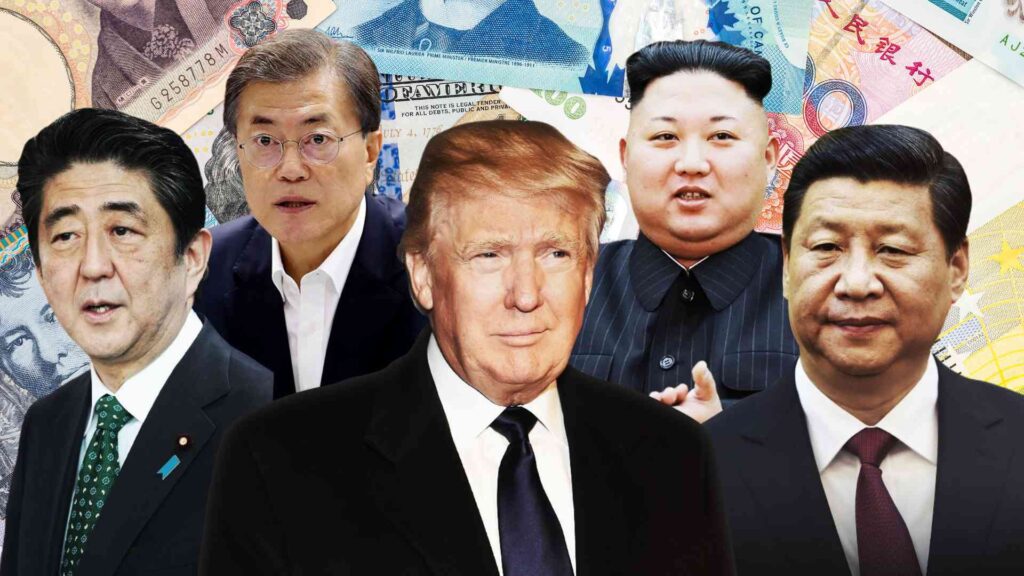
Asian diplomatic voices have long been sanguine about Trump’s election. His transactionalism is far less offensive here than in Europe.
European allies often invoke democracy as the key pillar linking them to America. For instance, Atlanticist elements of French politics trace common Enlightenment and even Roman ideals to the founding of their two states. However, this picture is very different in Asia.
The Reality of US Allies in Asia
Excluding Australia and New Zealand, US treaty allies in Asia are South Korea, Japan, the Philippines and Thailand. Of those nations, only Japan has a post-WWII democratic tradition. Even then, the Liberal Democratic Party (LDP) has been out of power for only six of those 80 years.
South Korea has only been a democracy since 1987, and President Yoon’s recent imposition of martial law shows authoritarian impulses remain. The Philippines’ post-WWII democracy was interrupted by the rule of Ferdinand Marcos. Thailand has gone through a consistent cycle of elections followed by military coups.
Democracy as a Secondary Concern for US Policy
Democracy has never been a predicate of US support. Until Reagan pressured South Korea’s Chun Doo-hwan to hold elections under the threat of mass unrest, the US backed its strongman anti-communist leaders against democratic protests. The US-Philippines relationship was strongest under Marcos’ rule, and the US has hardly been vocal in opposing Thailand’s military coups.
Even Taiwan, now widely considered Asia’s most vibrant democracy, was a US ally under the Kuomintang’s (KMT) one-party system. Its abandonment of Taiwan in 1979 is painted by certain voices today as a betrayal. But objectively, the US simply switched its recognition from one authoritarian regime to another.
Questionable Western Foundation Myths
In the West, we imbibe questionable foundation stories that consider democracy as integral to our nation states. US neoconservatives invoked the mythology of America as the inheritor of Athenian democracy when waging the post 9/11 War on Terror. Like the Greeks in the 5th century BC triumphing against the Persian empire, the US was portrayed as confronting barbarian eastern forces.
But this idealism is discordant with historical fact. The Athenian aristocrats Harmodius and Aristogeiton, celebrated today as democratic heroes, murdered one of the authoritarian rulers, Hipparchus, out of personal revenge rather than ideals. Cleisthenes’ subsequent democratic reforms owed much to his personal desire to win back power for his tribe, the Alcmaeonids.
Rome’s More Pragmatic View of Leadership
Athenian democracy and the later Roman Republic, often cited as inspirations for US political ideals, had a far more nuanced view of strongman rule. Roman rulers like Cincinnatus are held up as paragons of civic virtue, having assumed dictatorship twice to correct the country’s course before voluntarily stepping down. He is so admired that the city of Cincinnati is named after him.
Similarly, Sulla, who seized power in the first Roman Civil War, revived the office of dictator, purged his opponents, and then retired. This act has recently attracted admiration from figures like Elon Musk.
Asian Views on Democracy and Prosperity
So democratic nuances are not peculiarly eastern. Asian countries do not place the same importance on linking democracy, prosperity and freedom. None of the Asian Tigers became wealthy under democracy.
Hence, Asian governments can be more relaxed about Trump’s naked transactionalism. For some, it is even a refreshing change from a US government that trumpets democratic ideals while readily supporting dictators that align with its foreign policy objectives. One thinks of the famous quote often attributed to Franklin D. Roosevelt:
He may be a son of a bitch, but he’s our son of a bitch.
Uncertainty in Securing US Support
The more urgent concern for Asian nations charting a difficult path between the US and China is how to secure US support and whether it still counts for anything. Where democracy and freedom once appealed to idealistic elements of US politics, they now count for little if allies are merely pawns in a larger geopolitical game.
That is why recent cuts to Voice of America and Radio Free Asia, part of sweeping reductions in foreign aid, may concern allies in the region. China has openly supported these cuts, denouncing the platforms’ “appalling track record” and saying the programs have been discarded by the US government “like a dirty rag.”
The Challenge of a Might-Is-Right Approach
Elements of the new Trump administration clearly believe might is right. China is therefore best placed to wield its considerable power effectively and outmanoeuvre even those allies that attempt to appease the new US transactionalism. Even if allies open their markets and meet US trade demands, China can counteract these benefits through similar offers.
The Risks of Abandoning Ideals in Foreign Policy
The demise of ideals in US foreign policy is welcomed in some quarters. Nations that have long viewed American rhetoric on democracy as hypocritical see this shift as an honest reflection of realpolitik. However, this change also leaves countries uncertain about how to secure US support in the future.
A former US ambassador once remarked in Singapore about why this matters:
The US can make people dream in a way China never can.
If there are no ideals, no mythology (however muddled it may sometimes be), the US loses that advantage. And its allies may conclude that it is better the devil they know in their own backyard than with an unpredictable regime thousands of miles away.